I like to think I’m principled in my approach to life. I don’t play the lottery. I buy the cheapest apartment insurance possible. I’ve run the numbers.
So why the hell do I vote?
By a back-of-the-envelope estimate, future me will waste about ten hours voting in federal elections. Ten hours for something I’m pretty sure is useless. This is deeply unsettling, so naturally, I sat down and spent far more than ten hours proving whether those ten hours were, in fact, going to be wasted.
The calculation
The question we’re trying to answer is: what are the chances your vote actually matters? And I don’t mean “matters” in the warm-fuzzy-civic-participation sense that teachers tell you about in high school. I mean: what is the probability that your individual vote literally changes who becomes president?
This breaks down into two sub-questions:
- What’s the probability your vote flips your state?
- Given your vote flipped your state, what is the probability that flipping your state flips the whole election?
Multiply these together and you get the probability your vote changes the outcome. Then multiply THAT by how much better you think your candidate is than the other candidate, and you get a dollar amount representing the expected value of voting.
Mathematically:
A quick note on that \(\Delta V\) term: we use altruistic value – how much better society would be with your candidate – rather than personal gain. Why?
Because even if a candidate promised you $1 million personally if they win, the probability terms we are about to calculate are so small that your expected value would round to $0. Voting for pure self-interest makes no sense. The only coherent consequentialist framework for voting is caring about total societal value.
So that’s what we’ll estimate.
Part 1: What are the chances your vote flips the election?
Understanding polling error

Imagine every state’s votes are publicly displayed in a giant transparent box suspended in midair, with red and blue slips.
Pollsters are standing on the ground, looking up, trying to guess the red and blue slip totals. Since it is impossible to count the millions of slips in the giant box, each pollster does their best to count slips in various parts (read: sample) of the box to get an estimate of the true count. They may each count different parts of the box and from different angles (read: different methodologies) and therefore their guesses will vary. The Central Limit Theorem1 tells us that if you plot all these different estimates on a chart, they will cluster into a normal distribution centered around the true vote counts.
Starting simple: Splitville
Consider a small state called Splitville with:
- 100 voters (not counting you)
- Two candidates: Alice and Bob
- Polls show a perfect 50–50 tie
- Polling error with a standard deviation (\(\sigma_D\)) of 5 votes
Let \(D\) denote the difference in votes between Alice and Bob. Since the polls show a tie, the expected difference is \(\mu_D = 0\). We can model the vote difference as a normal random variable:
$$ D \sim \mathcal{N}(\mu_D, \sigma_D^2) $$A tie occurs when \(D=0\). Since we’re dealing with a continuous distribution but discrete vote counts, we apply a continuity correction and ask: what’s the probability that \(D\) falls within half a vote of zero? This means integrating the normal probability density function over the interval \([-0.5, +0.5]\). But for such a narrow range, a midpoint Riemann approximation works well – we can just evaluate the curve’s height at zero.
$$ P(\text{tie}) \approx \frac{1}{\sigma_D \sqrt{2 \pi}} \exp\Big(-\frac{(0)^2}{2 \cdot 5^2}\Big)= \frac{1}{5 \sqrt{2 \pi}} \approx 0.08 $$About an 8% chance of a tie in Splitville – pretty cool!
Revisiting the box analogy: national polling error
There is a big problem with our box analogy: what if there is a giant layer of red ballots sitting at the very top of every single box? Since every pollster is looking from below, none of them see those ballots. It doesn’t matter how many pollsters you have or how many “angles” they use – they are all going to miss those votes in the exact same way. This is systematic bias.
In practice, pollsters do their best to predict and correct for this, but this is why polling errors are highly correlated across states. In 2024, for example, the “hidden layer” favored Republicans, causing all seven swing states to move in the same direction.
To capture this effect, we need to decompose the polling error into two components 2:
- National error \(e_n\): The “hidden layer”. A shared shift that affects all states equally (e.g., polls systematically underestimating Republican turnout)
- State-specific error \(e_s\): The “different angles”. Independent noise for each state (e.g., local factors the polls missed)
The total polling error in a state is \(e_n + e_s\). We assume \(e_n \sim \mathcal{N}(0, \sigma_n^2)\) and \(e_s \sim \mathcal{N}(0, \sigma_s^2)\), where \(\sigma_n = 0.04\) and \(\sigma_s = 0.03\). Note that these are hyperparameters that seemed reasonable to me, not actually derived from historical data. Conveniently, since \(\sqrt{(0.03^2 + 0.04^2)} = 0.05\), our total error is 5%, matching historical error estimates.
Generalizing
For a real state, the logic is identical to Splitville. The only new wrinkle is that we need to condition on a sampled national error \(e_n\) (since we’ll average over it later via simulation) and compute the tie probability using only the state specific noise.
If we know the national error, we can just fold it into the margin. Then the chance a single vote flips a state is:
$$ P(\text{vote flips state} \mid e_n) = \frac{0.5}{\sigma_s N \sqrt{2\pi}} \exp\left( -\frac{(m + e_n)^2}{2\sigma_s^2} \right) $$where \(N\) is the number of voters, \(m\) is the polled margin, and \(\sigma_s\) is the state-specific error. The 0.5 accounts for tiebreaker mechanics3. This is similar to our Splitville formula, just with the margin shifted by the national error and the 0.5 numerator.
But knowing whether your vote flips the state isn’t enough. We also need to know whether flipping your state flips the election, and that depends on what happens in every other state. To compute this, we simulate.
How the simulation works
Each of our 100 million runs plays out one hypothetical election. We draw a national polling error, then for every state, draw a state-specific error and determine who wins. This gives us a complete electoral map. For each state, we compute the probability of a tie (using the formula above) and check whether that state was actually pivotal – would flipping it change the winner? Multiply those together, average across all runs, and we get:
The source code is short if you want the details.
Part 2: How much is the election actually worth?
Alright, we’ve figured out the probability side of the equation. Now for the hard part: what’s \(\Delta V\)? How much “value” does one candidate create over the other?
Before we dive in, note that everything we have calculated so far is independent of \(\Delta V\). So while I am about to do a lot of hand-waving, it doesn’t actually matter: plug in your own number and the rest of the analysis still holds.
I’ll use dollars as proxy, but \(\Delta V\) doesn’t have to be monetary. Feel free to measure it in lives saved, trees planted, vibes per capita, or whatever metric you care about. The framework is the same.
The federal budget as a proxy
The 2024 federal budget was about $6.8T. Let’s break it down.
- ~$1T goes to paying interest (can’t really change that)
- ~$4T goes to mandatory spending (e.g. Social Security, Medicare – needs legislation to change)
- ~$1.8T is discretionary spending (this is what the president can actually influence)
Over a 4-year term, discretionary spending is about $7.2 trillion. But within this bucket, candidates don’t fully differ – both will still fund the military, run agencies, and pay for programs. So what we care about are the marginal differences.
Quantifying this marginal difference is difficult, and us voters should be pretty conservative here since policies can have second-order effects that are hard to predict 4. If our preferred candidate is 5% more effective with this money, that gives us $360B.
The president also influences via legislation, Supreme Court appointments, foreign policy, etc. which are hard to quantify. Let’s conveniently estimate the 4-year impact of all these other factors at $140B, giving us:
$$\Delta V \approx 500B$$Putting it all together: 2024 election results
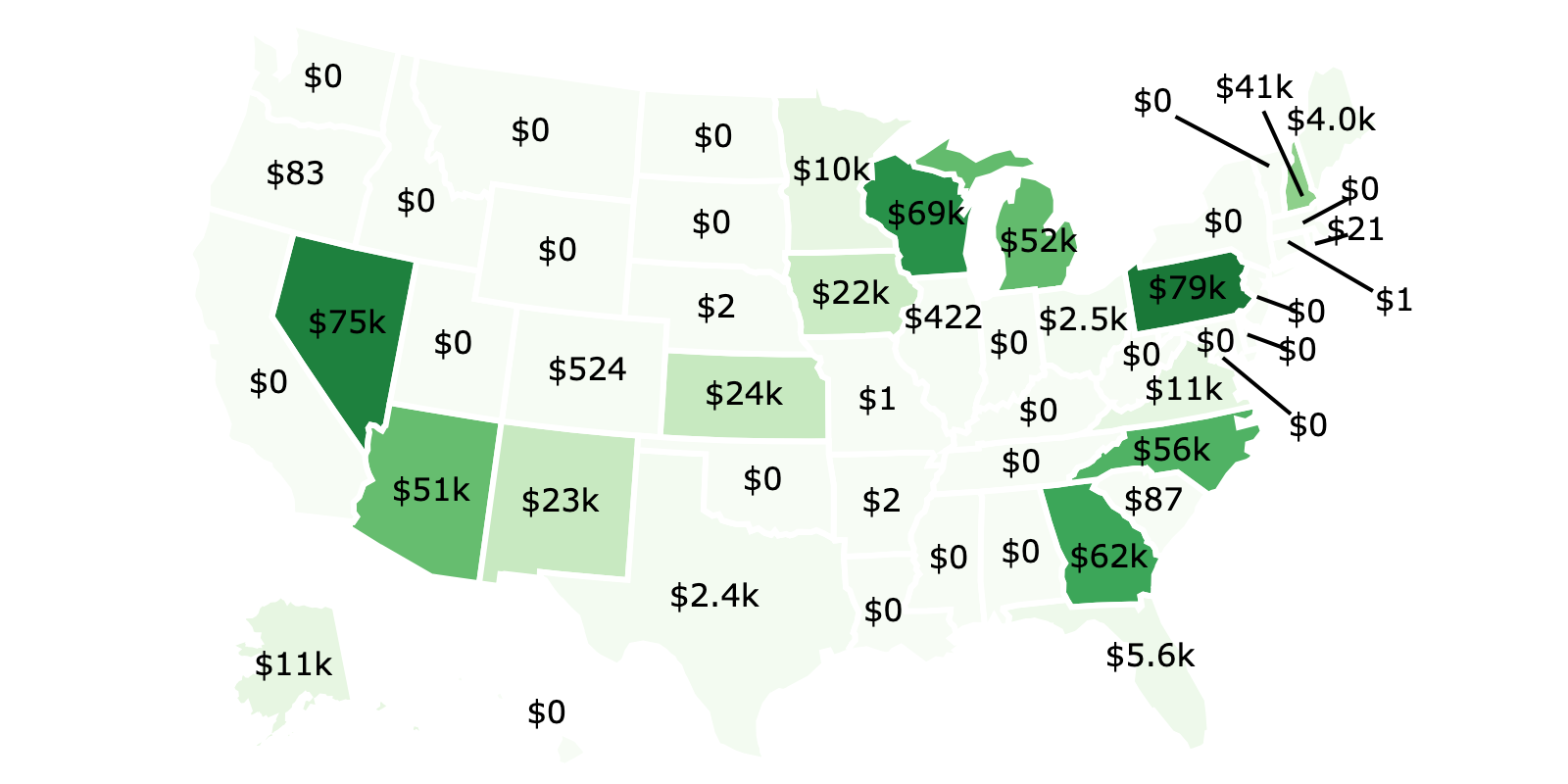
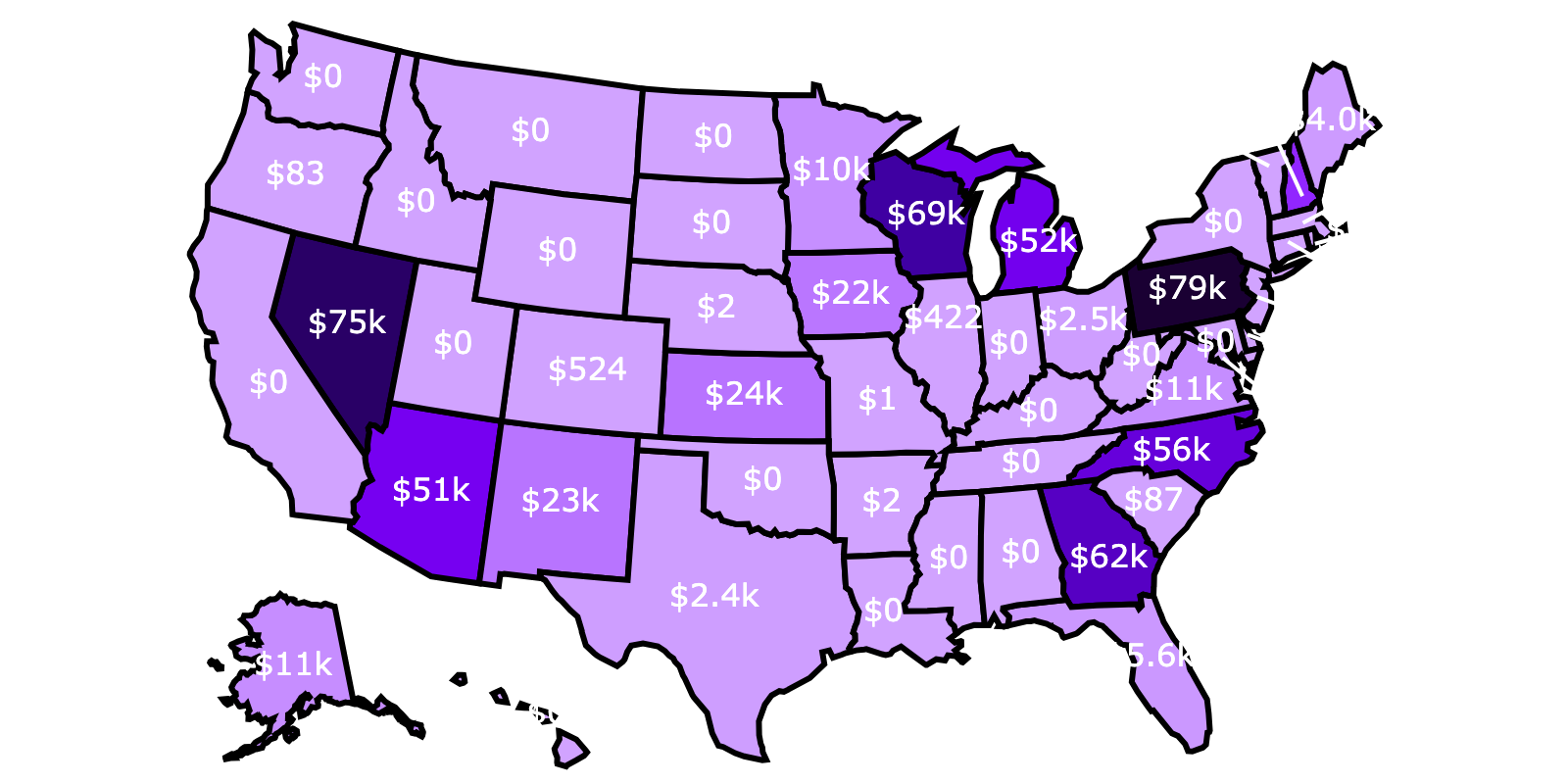
Let’s apply this framework to the 2024 presidential race. We used historical state-level polling margins and assumed a 4% national polling error and a 3% state specific polling error, set \(\Delta V\) to 500B, then ran 100 million simulations. Here are the results (the table is scrollable):
| State | P(vote flips state) | P(state flips election | vote flips state) | P(vote flips election) | EV |
|---|---|---|---|---|
| PA | 5.64e-07 | 28.14% | 1.59e-07 | $79k |
| NV | 2.66e-06 | 5.66% | 1.51e-07 | $75k |
| WI | 1.13e-06 | 12.23% | 1.39e-07 | $69k |
| GA | 7.32e-07 | 16.81% | 1.23e-07 | $62k |
| NC | 6.74e-07 | 16.62% | 1.12e-07 | $56k |
| MI | 6.55e-07 | 15.77% | 1.03e-07 | $52k |
| AZ | 1.10e-06 | 9.24% | 1.02e-07 | $51k |
| NH | 2.91e-06 | 2.80% | 8.16e-08 | $41k |
| KS | 1.80e-06 | 2.66% | 4.78e-08 | $24k |
| NM | 2.09e-06 | 2.24% | 4.68e-08 | $23k |
| IA | 1.53e-06 | 2.89% | 4.43e-08 | $22k |
| VA | 4.49e-07 | 4.89% | 2.19e-08 | $11k |
| AK | 3.25e-06 | 0.66% | 2.16e-08 | $11k |
| MN | 5.65e-07 | 3.60% | 2.03e-08 | $10k |
| FL | 1.68e-07 | 6.69% | 1.12e-08 | $5.6k |
| ME | 1.08e-06 | 0.73% | 7.90e-09 | $4.0k |
| OH | 2.08e-07 | 2.42% | 5.05e-09 | $2.5k |
| TX | 1.17e-07 | 4.16% | 4.87e-09 | $2.4k |
| CO | 1.67e-07 | 0.63% | 1.05e-09 | $524 |
| IL | 9.47e-08 | 0.89% | 8.44e-10 | $422 |
| SC | 1.01e-07 | 0.17% | 1.74e-10 | $87 |
| OR | 9.70e-08 | 0.17% | 1.67e-10 | $83 |
| RI | 1.51e-07 | 0.03% | 4.25e-11 | $21 |
| NE | 4.59e-08 | 0.01% | 4.64e-12 | $2 |
| AR | 3.72e-08 | 0.01% | 4.00e-12 | $2 |
| MO | 1.48e-08 | 0.02% | 2.34e-12 | $1 |
| CT | 1.33e-08 | 0.01% | 1.03e-12 | $1 |
| OK | 1.51e-08 | 0.01% | 8.53e-13 | $0 |
| NJ | 4.26e-09 | 0.01% | 3.00e-13 | $0 |
| IN | 5.78e-09 | 0.00% | 2.54e-13 | $0 |
| MT | 9.99e-09 | 0.00% | 6.70e-14 | $0 |
| DE | 8.19e-09 | 0.00% | 3.91e-14 | $0 |
| NY | 9.70e-10 | 0.00% | 2.62e-14 | $0 |
| WA | 5.86e-10 | 0.00% | 2.27e-15 | $0 |
| TN | 1.92e-10 | 0.00% | 8.16e-17 | $0 |
| MS | 2.00e-10 | 0.00% | 1.90e-17 | $0 |
| LA | 1.24e-10 | 0.00% | 1.50e-17 | $0 |
| HI | 1.95e-10 | 0.00% | 7.27e-18 | $0 |
| CA | 1.13e-12 | 0.00% | 6.92e-21 | $0 |
| UT | 5.87e-12 | 0.00% | 6.67e-21 | $0 |
| SD | 7.20e-12 | 0.00% | 1.81e-21 | $0 |
| ND | 4.92e-12 | 0.00% | 6.27e-22 | $0 |
| WV | 2.37e-12 | 0.00% | 3.27e-22 | $0 |
| MD | 4.87e-13 | 0.00% | 8.39e-23 | $0 |
| MA | 2.44e-13 | 0.00% | 2.00e-23 | $0 |
| KY | 2.62e-14 | 0.00% | 6.25e-26 | $0 |
| AL | 2.41e-14 | 0.00% | 5.85e-26 | $0 |
| VT | 1.07e-14 | 0.00% | 6.56e-28 | $0 |
| ID | 3.77e-18 | 0.00% | 4.94e-34 | $0 |
| WY | 3.20e-19 | 0.00% | 1.94e-36 | $0 |
| DC | 3.47e-103 | 0.00% | 2.51e-155 | $0 |
What this actually means
The electoral college is absurd
The median U.S. voter has roughly a 1 in 1 billion chance of swinging the election. A Pennsylvanian has about a 1 in 6 million chance. That makes the median voter worth about 0.5% of a Pennsylvanian. Whatever your feelings on the Electoral College, that’s a pretty weird system.
What can I do in $NON_SWING_STATE?
If you live in a state where your EV is ~$0, not all hope is lost.
Talk to your cousin. If you live in Oklahoma, your vote is worth ~43 cents. If you spend ten minutes on the phone convincing your cousin in Pennsylvania to vote, you’ve just performed a 180,000x force multiplier on your democratic power.
Swap your vote. Due to the two-party system, there are only two candidates ever “worth” voting for in expected value terms. But some people vote third-party anyway, presumably to “rage against the dying of the light,” as my friend put it. This opens the door to vote swapping: if Dave the Democrat lives in DC and his third-party friend Trent lives in Pennsylvania (and prefers Democrat to Republican), they can arrange a swap. Trent votes Democrat, Dave votes third-party, both are happier. This is legal in the U.S., but of course requires trust to work.
Vote locally. In a local toss-up election with 10,000 voters, there’s about a 1 in 125,000 chance of a tie – orders of magnitude more probable than swinging a presidential race. Lower turnout means your activism goes further too.
Conclusion
This entire analysis is an elaborate cope for something I was probably going to do anyway. And it treats voting as a means to an end, a pure mathematical decision.
Of course, there are plenty of reasons to ignore the numbers and vote: self-expression, civic duty, or simply using Election Day as a forcing function to stay politically informed. All valid.
But now when someone claims my vote matters, or that the Electoral College is a good thing, I can whip out my probability density functions and simulations and end the conversation immediately. Not because I’ve won, but because literally no one cares.
◆ ◆ ◆
Thanks to draft readers Siddharth, Varun, Michael, and Madhav.
-
This 3Blue1Brown video is a good explainer on the Central Limit Theorem. ↩︎
-
Ideally, we would just compute a covariance matrix between states from historical election data, since e.g. the error of polls in one state are likely more correlated to that of neighboring states than to that of far away states. ↩︎
-
Assume the tiebreaker is a coin toss. For even \(N\), without your vote, your candidate wins the tiebreaker with probability \(0.5\). For odd \(N\), with your vote, your candidate wins the tiebreaker with probability \(0.5\). Thus in either case, your vote only changes the outcome half the time. ↩︎
-
There are plenty of examples of this – see the Great Hanoi Rat Massacre as one of my favorites. Or consider that electing the worse candidate might be bad in the short-term but provoke reform and ends up being long-term net good. ↩︎